
Announcing the launch of the Great Lakes Maritime Initiative

So it has certainly been a busy fall, even though I have not been able to post regularly here. But much more is happening around maritime at the moment:
In just over two weeks, we will host PRADS 2025 at Michigan. We have over 180 academics, engineers, and shipbuilders from around the globe converging to discuss the state-of-the-art in ship design and production, with 136 papers scheduled for presentation. Conference proceedings will be out a few months after the event.
Today, my colleague, Associate Professor of Practice Thomas McKenney, and I are launching the Great Lakes Maritime Initiative. This is an effort to take the thought pieces I’ve been writing here and elsewhere to start connecting the dots through to application. We seek to address the needs of the maritime resurgence in policy, technology, production, and education. As a large Midwest public University, we are also looking to tie in our region’s unique strengths.
The background document that Thomas and I have prepared to describe GLMI is provided below. I have some thoughts on the future of decarbonization under Trump (which I will reserve until the IMO's net zero vote) and why we might be entering a new era for commercial/military production in the same shipyard. However, those pieces will have to wait until I am done chairing PRADS.
GLMI: Driving America’s maritime resurgence through innovation, collaboration, and education
As the United States undertakes a once-in-a-generation maritime revitalization, determining and supporting the optimal approach to recreate long-discarded capabilities is a central challenge. Commercial and military shipping, shipbuilding, and ship repair are uniquely complex and capital-intensive. Succeeding in this space requires tailored solutions built upon deep domain knowledge rather than generic re-shoring approaches. The Great Lakes Maritime Initiative (GLMI) aims to support this revitalization by providing national leadership across five critical pillars, highlighting the role the Great Lakes region’s industrial base can play in this revitalization.
The U.S. shipping and shipbuilding industries are not currently globally competitive and face urgent, well-documented challenges across the policy, workforce, and technology domains. While there is broad consensus on the need for revitalization, the path forward remains complex and uncertain. Workforce shortages are acute, with the U.S. lacking enough skilled mariners, shipyard workers, and engineers to meet current and future needs, even as demand for new ships and maintenance grows. The U.S. has also relinquished global leadership in maritime technology, intellectual property, and supply chain capacity for the numerous supporting systems essential to building ships. Such supporting systems frequently constitute over 60% of the shipbuilding value chain. Determining where to invest intelligently and which areas to prioritize is a key challenge in our maritime revitalization efforts. At the same time, the insertion of technologies in which the U.S. has global leadership, such as advanced manufacturing, nuclear power, and autonomy, could provide a springboard to increased maritime competitiveness.
The Great Lakes region is uniquely positioned to support the nation’s maritime revitalization. The region’s economy relies on maritime activities, and its industries excel in naval architecture, marine engineering, manufacturing, automation, and digitalization. Most value in shipbuilding comes from intermediate inputs – areas where regional companies and workforce can excel with the right support. The region is also well-suited for direct shipbuilding, including new or revitalized shipyards focused on smaller vessels and modules of larger ships. For research and development, the area has an extensive network of academic, government, and industry R&D facilities. Notably, the University of Michigan is the only large research university that has kept a stand-alone Naval Architecture and Marine Engineering (NA&ME) department, providing unmatched expertise and international partnerships.
The GLMI intends to build national discussion and regional capability across five pillars essential to meeting current commercial and military maritime challenges. These pillars are also shown graphically below:
Strategic maritime policy analysis: There are only a few examples of highly developed countries attempting to rebuild their maritime industries, and these have been mostly military-focused and on a smaller scale than the U.S.’ current need (e.g., Australia and Canada’s naval strategies). Determining the best way to invest to meet the nation’s short-term needs while building a lasting maritime capability is a central policy challenge that remains unresolved.
Ship production and supply chain innovation: Bringing together manufacturing expertise, business development, and certification knowledge to develop more efficient ship production methods. It is also essential to broaden the marine supplier base to include companies new to the maritime world and to determine how the nation’s strong startup ecosystem can support a capital-intensive and traditionally risk-averse industry.
Marine technology development and integration: The U.S. maintains global technology leadership in many areas (advanced nuclear, digitalization, autonomy and AI, energy storage and conversion) that could apply to maritime. How to best develop those technologies when needed, and ensure proper integration onboard vessels, remains a challenge.
Collaborative demonstration hubs: Access to advanced simulations and on-water data is a large barrier to many tech startups and new entrants into the maritime industry. Developing a regional network of land-based to full-scale testing facilities that can be utilized cost-effectively is crucial to growing the maritime industry.
Maritime education: A strong maritime industry requires education across merchant marine, skilled worker, engineering, and technology workforce components. Current graduate numbers in the United States appear insufficient to support our maritime ambitions. Developing transferable curriculum, online courses, certificate offerings, and in-career retraining can help increase the number of qualified people nationwide.
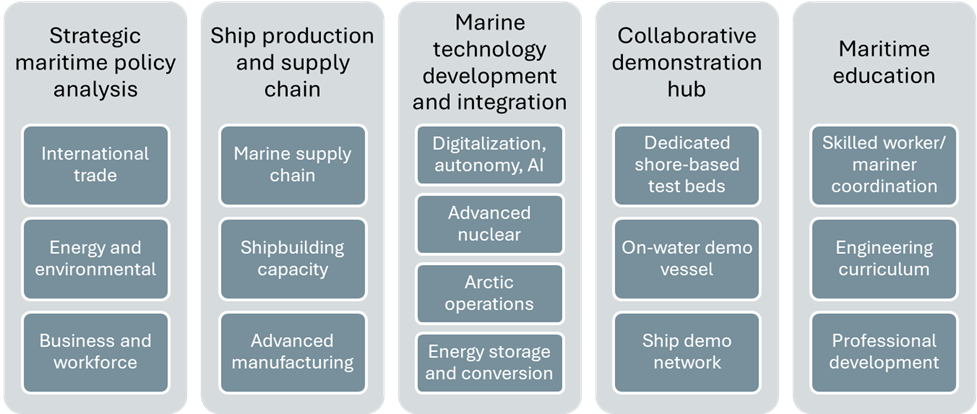
GLMI Pillars
Throughout Fall 2025, the GLMI will publish news articles and whitepapers, as well as host events centered on the five pillars discussed above. We invite you to stay connected via the GLMI website. We will also provide partnership opportunities for those interested in participating in the initiative’s work, and will announce more in early 2026. If you would like to develop a deeper partnership with the initiative, please contact the co-directors directly.